Organic Mattresses · Buying Guide
Naturepedic Halcyon Mattresses: How to Compare Comfort and Construction
A mattress is a quiet piece of engineering: layers of material, arranged in a particular order, asking the body to trust them for a third of the day. When comparing Naturepedic Halcyon models, the useful questions are not simply whether a mattress is “plush” or “supportive,” but what produces that sensation, how the layers work together, and whether the design suits the sleeper and the bed frame.
Published November 16, 2026
Halcyon is Naturepedic’s luxury mattress collection, a name that invites a certain atmosphere: a quiet room, a clean sheet, perhaps a morning that has not yet begun making demands. The practical work of choosing a mattress is less lyrical. It involves reading specifications, distinguishing surface comfort from underlying support, measuring a frame, and deciding how much importance to give materials, adjustability, and care.
Those details matter because a model name alone tells very little about how a mattress will feel. Two beds can both be described as organic, natural, or luxurious and still behave differently under the shoulder, hip, and lower back. The most reliable comparison begins with construction and ends with the sleeper’s own habits: sleeping position, temperature preferences, movement during the night, and whether two people need different levels of firmness.
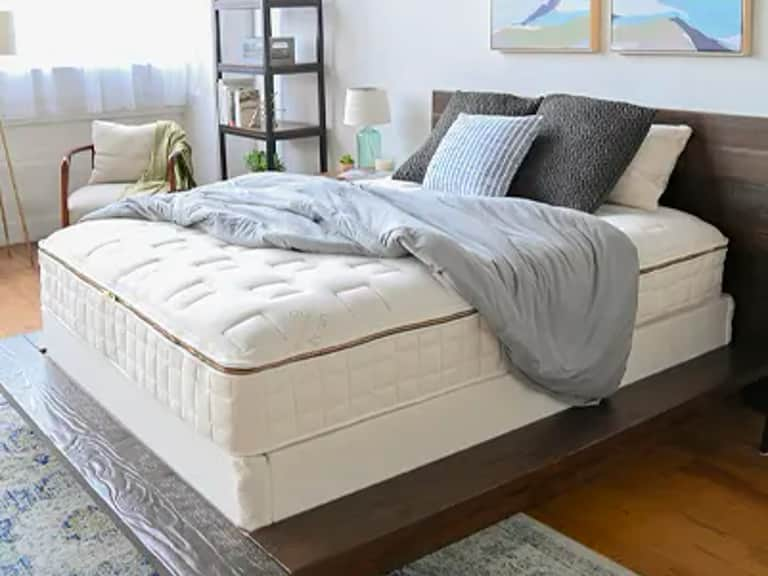
One example in the collection is the Naturepedic Azure Hybrid Organic Mattress. Its listed construction combines wrapped coils, Dunlop latex, and a wool blend that includes alpaca and cashmere. That gives shoppers a concrete starting point for understanding how a Halcyon mattress may bring together spring support, latex responsiveness, and natural-fiber comfort. Current specifications can vary by model or change over time, so confirm details with the seller before making a decision.
Begin with the layers, not the label
A mattress is a small landscape of unlike materials. The topmost layer is the first encounter: it influences the initial sensation of softness, the ease with which pressure is relieved, and how readily the surface gives way. Below it, a comfort layer can deepen cushioning or make the surface more responsive. At the bottom, the support system bears the larger task of holding the body in a balanced position.
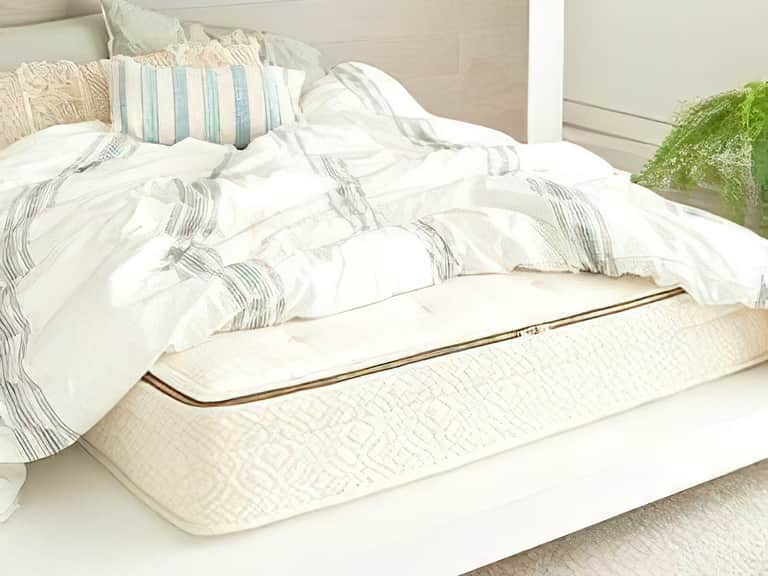
The Azure’s listed profile is 10 inches, with six inches of wrapped coils and three inches of organic Dunlop latex, alongside a luxury wool blend described as including organic wool, alpaca, and cashmere. A zippered organic cotton cover completes the stated construction. These materials do not tell a shopper precisely what the mattress will feel like—firmness is subjective, and a person’s weight and shape influence how deeply they settle—but they do clarify the design’s broad intentions.
Wrapped coils are individual springs enclosed in fabric pockets. In general, this arrangement allows coils to respond more independently than a single interconnected spring unit. That may help limit the spread of movement across the bed and give the mattress a spring-supported feel. The actual result depends on coil design, arrangement, and the layers above them; the phrase “wrapped coils” is a beginning, not a complete performance report.
Latex contributes a different quality. It tends to respond more quickly to pressure than traditional slow-response memory foam, so the sleeper may feel buoyed rather than gradually cradled. A latex layer can provide cushioning while preserving a sense of lift. People who prefer a mattress that does not seem to hold them in place may find this responsiveness appealing; others may prefer a more enveloping surface. Neither preference is a rule about what is healthiest or universally comfortable.
Wool and other natural fibers can contribute to the surface feel and help manage moisture and temperature. Their effect depends on the amount used, the way the layers are assembled, and the sleeper’s own warmth. A list of appealing materials is not a substitute for understanding how much of each is present and where it sits in the mattress. When a specification sheet is unclear, ask the retailer for the full layer breakdown rather than relying on a broad phrase such as “natural comfort.”
Comfort is a relationship, not a number
Firmness scales can make mattress shopping look more exact than it is. A rating of “medium,” if provided, is a useful shorthand for comparison, but it cannot predict how every person will experience a bed. Body weight, shoulder width, hip shape, preferred sleeping position, and even the bed base can alter the sensation. A mattress that feels gently supportive to one sleeper may feel rigid to another.
It helps to separate two questions that are often bundled together. The first is surface comfort: does the top of the bed cushion the places that press into it? The second is support: does the body feel held in a balanced position rather than sagging or being pushed out of alignment? A soft surface can sit above a supportive core, just as a firm-feeling surface can still fail to suit someone’s body. “Soft” and “supportive” are not opposites.
Side sleepers often notice pressure around the shoulder and hip, where the body meets the mattress most directly. They may prefer enough give to let those areas settle without creating a hammock-like dip through the middle. Back sleepers may look for a surface that cushions the lower back while preserving a stable, even feel. Stomach sleepers commonly prefer a surface that limits excessive sinking at the hips, though individual comfort remains decisive.
These are useful observations, not medical prescriptions. If persistent pain or a medical condition affects sleep, a mattress purchase should not be treated as diagnosis or treatment. The practical goal is to identify what a person currently notices—pressure, heat, stiffness, instability—and assess whether a particular construction plausibly addresses those preferences.
For couples, the question becomes more complicated in an ordinary way: two bodies share one rectangle. The Azure listing describes a dual-firmness design in Queen, King, and California King sizes, which may help accommodate different preferences on either side. Before relying on that feature, verify how the split is configured, whether the two sides can be selected independently, and what the available choices are in the exact size being considered. A specification for one size should not automatically be assumed to apply to every size.
What a customizable mattress can—and cannot—solve
Customization is appealing because comfort can be difficult to forecast from a showroom visit or a short trial. A mattress with adjustable choices may let shoppers select a feel that better matches their preferences, and a dual-sided arrangement can address a familiar household disagreement without requiring two separate beds. This is a meaningful advantage when the options are clear and the configuration suits the frame.
But customization does not eliminate the need to understand the construction. Ask what is adjustable: the firmness of a layer, the entire side of the mattress, or some other component? Can the layers be changed after purchase, or does “customizable” refer only to the original order? What are the costs, time limits, and shipping requirements for any adjustment? The answers distinguish a practical flexibility feature from a word that sounds reassuring in a product description.
It is also worth distinguishing adjustability from a guarantee of comfort. A person may choose a different feel and still need time to adapt. If the retailer offers a trial period or exchange, read the terms carefully: note the duration, any required break-in period, exchange fees, delivery arrangements, and whether the original packaging must be kept. These policies are part of the purchase, not fine print to discover after the mattress has arrived.
A useful comparison chart can keep the discussion grounded. For each model, record height, materials by layer, firmness choices, whether firmness can differ by side, available sizes, the type of foundation required, and the applicable trial or adjustment terms. If the information is missing, mark it as unknown. A blank is more honest—and more useful—than an assumption.
Organic claims deserve careful reading
For shoppers seeking an organic sleep environment, material descriptions and certifications are important evidence. They are not interchangeable. “Natural” is a broad description; “organic” makes a more specific claim, but the relevant scope depends on the material and the standard. A certification may cover a textile, a component, or a product’s processing requirements. It should not be taken to mean that every part of a finished mattress has identical certification status.
The Azure product information describes the mattress as certified to GOTS. Because certification details can be specific to the product, its components, and the current production run, shoppers should review the exact certification claim and ask what it covers. Look for current documentation from the brand or retailer, including the certificate holder, product or facility scope, and the materials included. If the information is not readily available, ask before treating a logo or phrase as proof of an entire mattress’s composition.
Other useful questions are straightforward: What is the cover made from? Which components contain latex, wool, or synthetic materials? Are any adhesives or treatments used? How is the mattress designed to meet fire-safety requirements? Clear answers make it easier to compare products according to personal priorities, whether those priorities are organic sourcing, reduced use of certain materials, or simply a complete understanding of what is in the bed.
Words such as “clean,” “non-toxic,” and “eco-friendly” are not, on their own, detailed ingredient lists or independent test results. A careful reader looks past the mood of the wording and asks for specific substantiation. This is not skepticism for its own sake. It is the ordinary discipline of matching a product’s claims to the shopper’s actual concerns.
Fit includes the frame, room, and delivery route
A mattress can be beautifully constructed and still be wrong for a particular bed. Confirm the length and width of the frame, the mattress height, and the depth of any existing fitted sheets or protectors. A 10-inch mattress may sit differently from a taller model, particularly when paired with a foundation or a deep-pocket sheet. The combined height of mattress and base can change how easy it is to get in and out of bed.
Check the manufacturer’s guidance on foundations, platforms, slats, and adjustable bases. Slat spacing and center support can matter to the way a mattress is supported and to its warranty terms. Do not assume that a bed frame suitable for one mattress will automatically be appropriate for another. If the frame is old, measure it and inspect its condition before ordering.
Delivery logistics deserve similar attention. A mattress made with substantial layers can be heavy and awkward to move, and access may be complicated by narrow stairs, turns, or a small elevator. Ask how the mattress arrives, whether assembly is required, what services are included, and what happens to packaging. These questions are unromantic, but they can preserve a purchase from a preventable and rather exhausting surprise.
Care and durability are part of comfort
Mattress care is often reduced to the instruction to use a protector, which is sensible but incomplete. Read the care guidance for the particular model. A zippered cover may invite curiosity, but it does not necessarily mean the cover is intended to be removed or laundered at home. Follow the manufacturer’s directions rather than treating a zipper as an invitation to disassemble the bed.
A breathable, washable mattress protector can help guard against spills, sweat, and everyday wear. For a mattress with natural fibers, choose one that fits securely and does not introduce a thick, stiff layer that changes the surface feel. Bedding is a system: a protector, fitted sheet, and topper can all affect airflow and the way the mattress responds. If a new bed suddenly feels too warm or too firm, consider whether an added layer is part of the explanation.
Durability is difficult to infer from material names alone. Ask what the warranty covers, what exclusions apply, and what support surface is required. Warranties typically address defined defects rather than every change in comfort or appearance, so read the terms instead of treating the warranty period as a forecast of how long the mattress will feel unchanged. A mattress’s useful life depends on construction, care, use, and the sleeper’s expectations.
A measured way to compare Halcyon options
Rather than trying to decide by headline claims, compare each candidate across a few practical dimensions. First, identify the overall sensation you want: buoyant or contouring, gently cushioned or comparatively firm, springy or quiet. Then examine which layers are likely to create that sensation. The goal is not to guess perfectly from a description; it is to make the description answerable to your preferences.
- Construction: Write down the materials and thickness of each layer, not merely the material names.
- Support: Identify the core system—such as coils or latex—and ask how it is intended to support the sleeper.
- Feel: Compare firmness choices and clarify whether they refer to the surface, the support system, or the overall mattress.
- Shared sleep: Check whether a dual-firmness option is available in the size you need and how the sides are configured.
- Materials: Verify the scope of organic or other certification claims and ask for current documentation.
- Practical fit: Confirm dimensions, frame compatibility, delivery access, assembly, and care requirements.
- Purchase terms: Read the trial, exchange, return, and warranty policies before placing an order.
Keep the comparison modest. A spreadsheet with several columns is often more useful than a long list of adjectives. If two mattresses appear close, focus on the differences that matter to you: whether you share a bed, whether you sleep hot, whether you prefer the quick response of latex, and whether a separate firmness on each side would make daily life easier.
The final test is a night’s sleep
There is an understandable temptation to treat mattress shopping as a search for a perfect specification: the one material, certification, or firmness that will settle every question. A mattress is more personal than that. Its construction can be explained; its comfort has to be experienced. Specifications help narrow the field, but they cannot reproduce the feeling of turning over at two in the morning or waking after a full night.
For the Azure, the available details—wrapped coils, Dunlop latex, wool and other natural fibers, a cotton cover, and a dual-firmness option in selected sizes—offer a reasonably clear picture of the design’s direction. They suggest a hybrid approach that combines spring support with latex responsiveness and a natural-fiber comfort layer. Whether that arrangement feels right depends on the sleeper, the chosen firmness, the bed base, and the bedding placed on top.
Naturepedic Halcyon mattresses are best compared as constructions rather than as names in a collection. Read the materials list carefully, distinguish comfort from support, verify the certification and customization details, and measure the bed before ordering. Then give the mattress trial and care terms the same attention you give its surface. A considered choice is not necessarily the most elaborate one. It is the one whose materials, feel, and practical demands make sense in the room where it will be used.
Frequently asked questions
What construction details are listed for the Naturepedic Azure?
The listed profile is 10 inches, with six inches of wrapped coils and three inches of organic Dunlop latex, plus a wool blend described as including organic wool, alpaca, and cashmere. The product information also describes a zippered organic cotton cover. Confirm current specifications with the retailer before purchase.
Does a dual-firmness mattress mean each side can be selected independently?
The Azure listing describes a dual-firmness design in Queen, King, and California King sizes. Shoppers should verify the available configurations for the exact size they want and confirm how each side is selected.
How should I compare firmness?
Use firmness descriptions as a starting point, then consider sleeping position, pressure points, body shape, and whether you prefer a buoyant or more contouring feel. If possible, use the retailer’s trial or exchange terms to assess the mattress at home.
What should I verify about organic certifications?
Ask which parts of the mattress a certification covers and request current documentation. A material or product certification should be interpreted according to its stated scope rather than assumed to apply identically to every component.