Sustainable Sleep · Materials Guide
Latex Layers: Choosing the Right Feel and Support
Latex can feel buoyant, gently cushioning, or unexpectedly firm. The difference lies not in a single label but in the meeting of firmness, layer thickness, construction, and the sleeper above it. A thoughtful choice begins with the surface you have—and the way your body meets it.
There is a particular clarity to lying on a latex sleep surface. Unlike materials that seem to receive the body gradually, latex tends to answer it at once: pressure in, lift back. The sensation can be springy without being bouncy, supportive without feeling rigid. Yet “latex feel” is no more a single experience than “wood feel” is a description of every chair. A thin topper and a deep mattress can behave quite differently; a soft layer over a firm base is a different proposition from a firm layer on its own.
For anyone comparing latex sleep surfaces, the most useful questions are practical. How much cushioning do you want at the shoulders and hips? Does your current mattress sag, or is it simply too hard? Do you sleep mainly on your side, back, or stomach? And what does “support” mean in your case: a firmer sensation, a more level sleeping posture, or less pressure at particular points?
These questions matter because comfort is not determined by firmness alone. Layer thickness, material density, sleeping position, body weight, the underlying mattress, and even the cover can all alter the result. The aim is not to find the softest or firmest latex available. It is to find a combination that lets the body settle comfortably while keeping the sleep surface adequately supportive.
Firmness is a useful clue, not a verdict
Firmness labels are helpful for narrowing a search, but they are not universal measurements of how a bed will feel. One maker’s medium may feel firmer or softer than another’s. In addition, the same latex layer can feel different to people with different body shapes and weights. Someone who presses deeply into a surface may experience more contouring than a lighter sleeper, who may feel closer to the top of the material.
Latex firmness is often described in terms such as soft, medium, or firm, and some manufacturers provide a technical measure of the material’s resistance to indentation. Such figures can help compare layers within a particular product range. They do not, by themselves, predict comfort. The feel of a mattress is created by the entire construction: the latex, its thickness, the layers beneath it, the cover, and the support system below.
It is useful to distinguish surface softness from underlying support. A soft upper layer can cushion the body while a firmer layer below limits how far it sinks. Conversely, a mattress that feels firm at first contact may still allow certain areas to sink more than others, depending on its construction and the sleeper’s build. A good match tends to balance two sensations: enough give to ease pressure, and enough lift to avoid feeling as if the body is dropping into a hollow.
Thickness changes the conversation
Layer thickness affects how much material stands between the sleeper and the firmer structure beneath. A thin latex topper may slightly soften a mattress without transforming its basic character. A thicker layer can create a more noticeable cushion and allow greater contouring, though the outcome still depends on firmness and what lies below it.
For a mattress that is generally supportive but a little unforgiving at the shoulders or hips, a modest topper may be enough to add comfort. If the existing mattress is substantially too firm, a thicker layer may make a more meaningful change. But a topper is not a reliable remedy for a mattress with a pronounced sag, broken support, or an uneven base. Adding softness over a failing surface can mask the problem briefly without restoring the level support the mattress no longer provides.
Thickness can also affect the sense of connection to the bed. A thinner layer may preserve more of the original mattress feel; a thicker one may create a distinct new surface. Neither is automatically preferable. People who like a close, responsive feel may appreciate a more substantial layer, while those who mainly want to take the edge off a firm bed may prefer a subtler adjustment.
A simple way to think about layering
The upper layer chiefly influences first contact and cushioning. The layers below contribute to how far the body settles and how the surface responds. A softer top over a firmer foundation can offer comfort with structure, but the result depends on the sleeper, the mattress, and the combined thickness—not just the label on one layer.
Let sleep position guide the first comparison
Sleep position offers a useful starting point, though it should not be treated as a rigid rule. Side sleepers often place more concentrated pressure on the shoulders and hips. They may prefer enough cushioning for those areas to settle into the surface, while still keeping the torso from sinking unevenly. A softer or thicker latex layer can sometimes provide that extra give, but a very yielding combination may feel unstable to some sleepers.
Back sleepers often look for a surface that supports the natural shape of the body without creating an exaggerated dip around the pelvis. A medium feel may suit some, while others prefer firmer or softer arrangements according to body shape, weight, and personal comfort. What matters is whether the surface feels level and comfortable through the night, rather than whether a category name appears to match a position.
Stomach sleepers frequently prefer a firmer, more restrained surface. If the hips sink too far relative to the rest of the body, the position may feel uncomfortable. A thinner or firmer latex layer can preserve a more lifted sensation, though individual preferences and mattress construction still matter. Combination sleepers, who change position, may value latex’s quick response: it tends to recover its shape readily, making it easier to move than some slower-contouring foams.
For people who move between positions, the question is not only how a bed feels in the position they begin in, but whether it remains comfortable as they turn. A layer that seems wonderfully plush while lying still may feel less suitable if it makes repositioning difficult. The responsive character of latex can be appealing in this respect, but firmness and thickness remain decisive.
Body weight and shape affect the experience
Two sleepers can lie on the same mattress and report different sensations, without either being mistaken. Body weight influences how deeply a person compresses a layer; body shape affects where pressure is concentrated. A sleeper with more weight around the hips, for example, may experience a different balance of support and cushioning from someone with a more evenly distributed build.
As a broad tendency, lighter sleepers may experience a surface as firmer because they compress it less. Heavier sleepers may sink farther into the same layer and perceive more softness, though they may also need a sturdier construction to maintain a comfortable, supported feel. These are tendencies, not prescriptions. A person’s preferred sensation can differ from what a generic guide might predict, and pressure sensitivity, temperature preferences, and habitual posture all deserve consideration.
Couples face an added complication: the same layer must work for two bodies, or the construction must accommodate different needs. If the mattress allows different firmness settings on each side, that flexibility may be worth investigating. Otherwise, a compromise often comes down to which discomfort is more important to address—excess pressure, too much sink, or a general lack of responsiveness.
Dunlop and Talalay: construction shapes feel
Natural latex is commonly made using Dunlop or Talalay processes. Both can produce resilient latex, but the methods differ, and the resulting materials may be offered in different firmnesses and constructions. Dunlop is generally made in a way that produces a denser, heavier-feeling material, while Talalay involves additional processing steps that can yield a more uniform, airy structure. These descriptions are useful shorthand, not guarantees of a particular comfort experience.
It is tempting to treat the process name as a verdict—Dunlop for support, Talalay for softness—but that is too simple. A soft Dunlop layer can feel quite different from a firm one, and the same is true of Talalay. The mattress design, layer order, thickness, and the sleeper’s response matter at least as much as the process. When comparing products, look for the specified firmness and construction details rather than relying on broad claims about one type always being better.
Material descriptions also deserve careful reading. “Natural latex” and “organic” are not interchangeable terms, and product claims can refer to different components of a mattress. A mattress may combine latex with cotton, wool, or other materials. Check which components are certified, what the certification covers, and whether the manufacturer explains sourcing and construction clearly. Clear documentation is more informative than a reassuring adjective on its own.
When a customizable mattress can help
Layered construction can make adjustments more practical. If a mattress contains separate latex layers, changing their order or firmness may alter the feel without replacing the entire bed. This can be useful for households whose preferences are uncertain, or for sleepers who want to fine-tune a surface after trying it at home. The benefit depends on the specific mattress: not every model is designed for rearrangement, and not every layer can be exchanged.
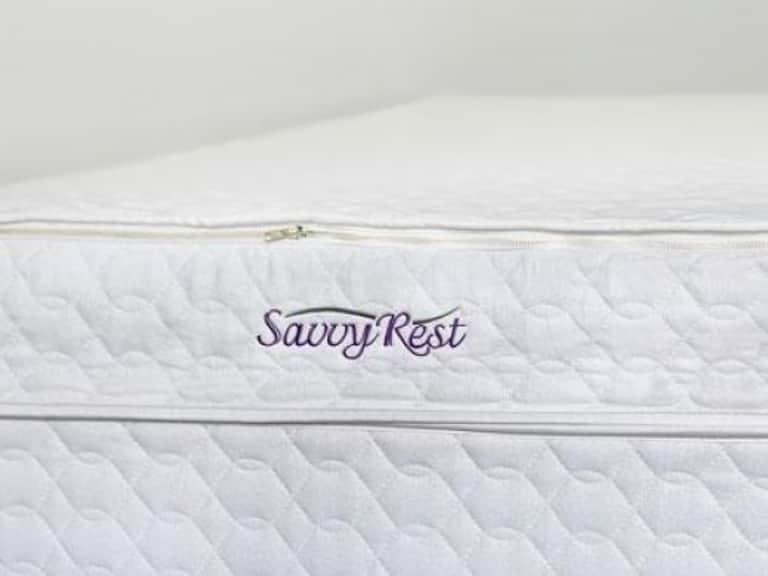
The Savvy Rest Tranquility Latex Mattress is one example of a customizable, layered latex design. It is described as a 7-inch mattress made with two 3-inch layers, available in Dunlop, Talalay, or a combination of the two, with an organic cotton cover and an organic wool flame barrier. Its construction illustrates how layer choices can shape the feel of a latex sleep surface. The product information also identifies a 160-pound weight limit, so anyone considering it should review that specification and confirm suitability for their needs.
Customization is most helpful when it comes with a clear process: what can be changed, how the exchange works, whether there are fees, and how long the trial period lasts. A theoretical ability to rearrange layers is less valuable if the instructions are unclear or the practical terms are restrictive. Before buying, read the exchange policy and warranty, and confirm whether the mattress is compatible with the foundation or adjustable base you plan to use.
Ventilation, temperature, and the whole bed
Latex is often described as breathable and temperature-neutral, and its resilient structure can allow air to move through the material. Still, no mattress material can guarantee that every sleeper will sleep cool. Temperature is influenced by the room, bedding, mattress cover, sleepwear, humidity, and individual physiology. A thick protector or densely quilted cover may alter airflow and surface feel, regardless of the latex beneath.
When warmth is a concern, consider the complete sleep system. Natural-fiber sheets and a breathable mattress protector may preserve more of the underlying feel than heavier, less permeable layers. A topper can also change how closely the body rests against the mattress and how much warmth is retained. If you already sleep hot, consider what you use now before adding another layer—and look for specific information about cover materials and care rather than relying on broad claims about cooling.
Care and durability deserve a place in the decision
Latex is valued for resilience, but durability depends on the quality and construction of the product, how it is used, and the support beneath it. A sound foundation helps the mattress perform as intended. Follow the maker’s guidance for rotation, if applicable, and avoid bending or storing the mattress in ways the manufacturer does not permit.
Care instructions vary. Some latex layers are enclosed in covers that should not be removed or washed; others may have removable covers with their own washing guidance. Latex itself generally should not be treated as though it were an ordinary washable textile. Check instructions before cleaning, keep liquids away from exposed material, and use a compatible protector if appropriate. A protector can help guard against spills and everyday soil, though it may affect the feel and airflow of the surface.
Durability is also part of environmental decision-making. A long-lasting mattress can reduce the frequency of replacement, but sustainability cannot be inferred from longevity alone. Material sourcing, manufacturing, certification scope, repairability, transport, and end-of-life options all contribute to the larger picture. A careful purchase is often one that fits well enough to be used for years, rather than one chosen primarily for a label.
A practical comparison checklist
Before choosing a latex layer or mattress, write down what your existing sleep surface does well and what it does poorly. “Too firm” is a start; “pressure at the shoulder while side sleeping” is more useful. The more clearly the problem is described, the easier it becomes to judge whether a softer or thicker layer might address it.
- Identify the problem. Is the mattress too firm, too soft, uneven, or simply lacking pressure relief?
- Consider your usual position. Think about where your body feels pressure and whether you change positions often.
- Compare thickness and firmness together. A soft thin layer and a soft thick layer may create very different experiences.
- Check what lies underneath. A topper can adjust a sound mattress, but it cannot reliably repair sagging support.
- Read the material details. Look for the type of latex, other mattress components, and clear information about any certifications.
- Review return and layer-exchange terms. Confirm the trial period, costs, deadlines, and exact process for making changes.
- Check care and compatibility. Confirm instructions for the cover, protector, foundation, and adjustable base.
- Give adjustment time. When possible, evaluate a new surface over a reasonable period and note how it feels in different positions.
The right feel is the one that works through the night
Latex can offer a distinctive combination of cushioning and lift, but neither quality is fixed. Firmness determines how readily the material yields; thickness influences how much of it the body meets; construction shapes the material’s character; and the sleeper brings weight, posture, and preference to the equation. The mattress beneath the layer may matter as much as the layer itself.
Rather than pursuing an abstract ideal—perfectly soft, perfectly firm, or universally supportive—look for a surface that reduces the discomfort you actually experience. A side sleeper may need more room for the shoulders and hips; a stomach sleeper may prefer a steadier feel; a combination sleeper may prize easy movement. These are useful starting points, not rules carved into the foam of the marketplace.
The most dependable comparison is the one that joins material facts to lived comfort. Read the construction details, check the policies, and consider the whole bed rather than a single layer in isolation. Then ask the quiet question that matters most after the first impression has faded: does this surface let you settle, stay supported, and wake without wishing it had been something else?